"Applications are no longer the primary unit of software architecture. Decisions are."
The AI industry is repeating a mistake we have already made.
A decade ago, every enterprise wanted Kubernetes. Executives asked, “Should we move to containers?” The companies that succeeded did not simply adopt Kubernetes. They built Platform Engineering teams. Those teams created internal developer platforms, CI/CD pipelines, golden paths, observability, security, governance, service catalogs, and deployment standards. Kubernetes became valuable not because of containers, but because Platform Engineering transformed infrastructure into a consumable product.
History is repeating itself. Instead of asking, “How many AI agents should we build?” organizations are asking, “Which LLM should we use? Should we use MCP? Should we build multi-agent systems?” These are important questions, but they miss a more fundamental shift that is already underway.
For the last thirty years, every enterprise system was built around applications - CRM, ERP, billing, ticketing, monitoring. Each application owned its data, its logic, and its UI. AI changes this because AI does not consume applications. It consumes capabilities: retrieve a customer record, check a policy, execute a workflow, observe an outcome. The atomic unit of value is no longer the application. It is the decision.
This has a profound consequence: if decisions are the new unit of architecture, then decisions need a platform. They need shared context, consistent logic, governed execution, and continuous evaluation. Without that platform, every new agent becomes another production system with its own prompts, memory, APIs, security model, governance process, evaluation framework, and operational burden. Agents do not reduce complexity. Without a platform, they multiply it.
This is why AI is a cost center in most enterprises today. Disparate agents, each with its own stack, each requiring its own maintenance, each duplicating the same infrastructure. The costs are visible - model API bills, GPU instances, headcount for prompt engineering. The value is scattered across experiments that never compose into a system. The ledger shows spend on one side and isolated proofs of concept on the other.
This is the case for why the platform comes first - and what it actually looks like.
The Wrong Mental Model
Most organizations imagine AI like this:
LLM → Agent → Business Value
Reality looks more like this:
Platform → Context → Enterprise Reality Model → Decision Logic → Actions → Governance → Agents → Business Outcomes
The agent is only the visible tip of a much larger system. Just as developers rarely think about Kubernetes internals today, future AI developers should not think about model routing, vector databases, permissions, evaluation pipelines, or prompt management. Those become platform capabilities.
Notice where the decision sits in that second diagram. After context and reality. Before governance and action. The agent is last. The platform exists to serve the decision.
A Better Analogy: The Enterprise as an Operating System
The best way to understand enterprise AI is not through chatbots. It is through operating systems.
Imagine the enterprise as a distributed operating system:
| Operating System | Enterprise AI |
|---|---|
| Kernel | AI Platform |
| Processes | AI Agents |
| Memory | Enterprise Context |
| File System | Knowledge and Documents |
| Scheduler | Decision Engine |
| System Calls | Business Actions |
| User Permissions | Identity and Governance |
| Device Drivers | Enterprise Connectors |
| Logs | Observability |
| Package Manager | Model Registry |
| Process Supervisor | Agent Runtime |
Agents are not applications. They are processes. The platform is the operating system.
The most important row in that table is the Scheduler. In an operating system, the scheduler decides which process runs, when, and with what resources. The Decision Engine is the enterprise equivalent. It is the layer that makes the architecture about decisions rather than agents.
Across industries, the decisions themselves follow a universal pattern. The verbs are the same. Only the objects change:
| Verb | Retail | Telecom | Banking | Healthcare | IT |
|---|---|---|---|---|---|
| Approve | Refund | SIM Activation | Loan | Admission | Deployment |
| Reject | Return | Service Request | Transaction | Treatment | Release |
| Allocate | Inventory | Network Capacity | Credit | ICU Beds | Compute |
| Prioritize | Orders | Incidents | Customers | Patients | Alerts |
| Recommend | Products | Plans | Investments | Treatments | Architecture |
| Recover | Orders | Network | Payments | Systems | Services |
| Optimize | Pricing | Routing | Portfolio | Scheduling | Infrastructure |
| Predict | Demand | Churn | Default | Readmission | Capacity |
| Authorize | Discounts | Roaming | Transfers | Prescriptions | Actions |
| Schedule | Deliveries | Maintenance | Collections | Surgeries | Deployments |
| Detect | Fraud | Outages | AML | Disease | Anomalies |
| Retire | Products | Towers | Accounts | Equipment | Applications |
Approve, reject, allocate, prioritize, recommend, recover, optimize, predict, authorize, schedule, detect, retire. These twelve verbs are the new system calls. Every enterprise decision is a combination of them applied to industry-specific objects. The platform exists to standardize how these decisions are made, evaluated, and learned from - regardless of the industry or the object.
The Eight-Layer Enterprise AI Platform
Here is what the platform looks like when you stop thinking about agents and start thinking about operating systems.
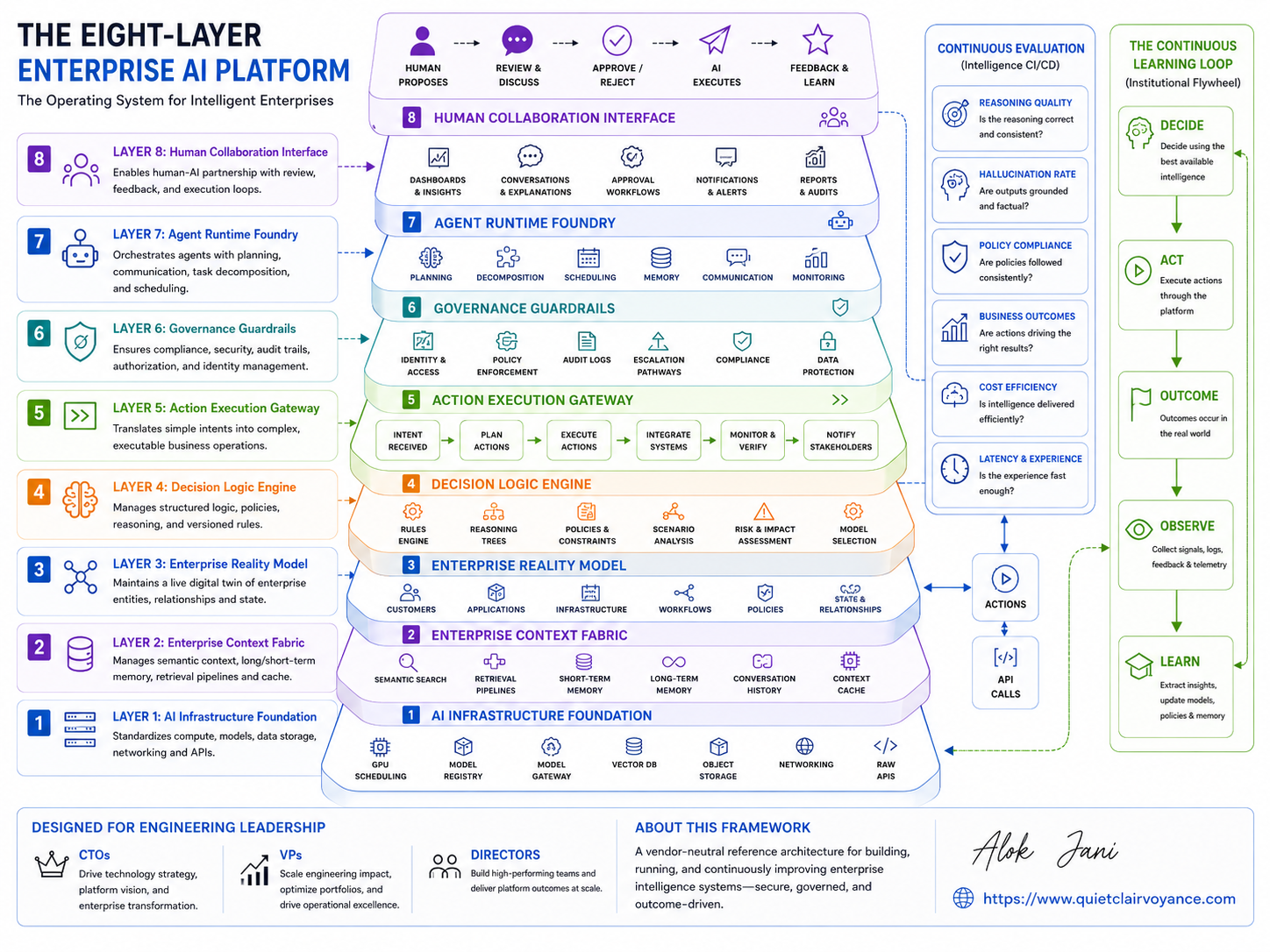
Layer 1 - Compute Foundation
Every operating system begins with infrastructure. This layer abstracts GPU scheduling, inference gateways, model routing, model registry, caching, vector databases, embeddings, storage, and networking. Application teams should never worry about GPUs any more than they worry about CPU schedulers. Infrastructure disappears behind APIs. A model gateway provides a single API to access any model provider without managing GPU infrastructure underneath.
Layer 2 - Context Fabric
The industry is obsessed with models. The next competitive advantage will not be models. It will be context. Context includes enterprise documents, semantic search, retrieval pipelines, long-term memory, short-term memory, conversation history, identity-aware retrieval, context caching, structured knowledge, and feature stores. The smartest model with poor context performs worse than a smaller model with excellent context. Context becomes infrastructure. A customer support agent retrieving account history, open tickets, and billing status from a vector knowledge base before responding - this is retrieval-augmented generation in practice.
Layer 3 - Reality Model
This layer solves a specific problem: enterprise data lives in dozens of disconnected systems, but AI needs to reason over complete entities. An Enterprise Reality Model is a live operational model of the business that connects related data into unified business objects with their relationships, current state, and available actions.
Consider a telecom agent troubleshooting a cell tower outage. Without an Enterprise Reality Model, the agent queries five systems - network inventory for tower specs, CRM for affected customers, billing for SLA penalties, ticketing for maintenance history, and workforce management for field crew availability. With it, the agent asks for “tower T-422” and receives a single object containing its location, status, affected subscriber count, active tickets, SLA exposure, and assigned technician.
Or consider a logistics agent rerouting a delayed shipment. Without an Enterprise Reality Model, it checks the shipment tracking system, then the warehouse inventory system, then the carrier schedule system, then the customer notification system, then the billing adjustment system. With it, “shipment S-8812” is a single object that knows its current location, contents, delivery deadline, alternative carriers, and customer notification preferences. The agent changes one field - “carrier” - and the model propagates the update to every downstream system.
This is not a database. Databases store rows. An Enterprise Reality Model stores business reality. It makes the enterprise knowable to AI in the same way an operating system makes hardware knowable to applications.
Layer 4 - Decision/Logic Engine
This layer is why the article has the title it does. If decisions are the new unit of architecture, they need a place to live, and that place is not inside a prompt. Most AI systems follow this pattern: data in, prompt, LLM, output. Enterprise systems require something different: data, business logic, policies, reasoning, AI, decision. Business logic should never be hidden inside prompts. It must be versioned, testable, composable, observable, reusable, and governed. Reasoning becomes software. A loan approval agent using decision models that encode regulatory LTV ratios, credit score thresholds, and risk policies as executable rules rather than relying on the LLM to infer them from a prompt is the difference between auditable compliance and guesswork.
Layer 5 - Execution Gateway
Most architectures expose tools. The future exposes actions. There is a difference. A tool executes an API. An action executes a business capability. “Recover Production Service” may internally perform restart workloads, drain nodes, update incidents, notify engineers, verify health, and close tickets. The AI reasons in business language. The platform translates that into technical execution. This is the enterprise equivalent of a system call.
There is a catch. In most large enterprises, AI does not talk to clean modern APIs ninety percent of the time. It talks to SAP, legacy CRMs, on-prem databases, and mainframes. Without a dedicated integration fabric that translates business actions into legacy protocols, this layer becomes an unmaintainable mess of custom-coded connectors. The Execution Gateway must include an integration middleware layer that handles protocol translation, data transformation, and transactional reliability between the AI platform and the enterprise’s existing systems.
An engineer telling an agent “restore the database from last night’s backup” should trigger a single action that orchestrates backup snapshots, infrastructure updates, and notifications - not four separate tools the engineer has to sequence manually.
Layer 6 - Governance
Governance cannot be bolted onto AI. It must be part of the operating system. Every AI capability requires identity, authorization, approvals, policy enforcement, audit logs, versioning, lineage, compliance, secrets management, and human escalation. An agent should possess the same - or fewer - permissions than the employee it assists. Identity becomes the foundation of trust.
This layer must also address adversarial AI security, which traditional compliance frameworks miss. Enterprise AI needs real-time defense against prompt injection, jailbreak attempts, and data exfiltration. If an employee or external actor tries to trick an agent into leaking proprietary source code or accessing unauthorized data, that threat must be intercepted before it reaches the Logic Engine or Context Fabric. This requires runtime input sanitization, output guardrails, and behavioral monitoring that detects attack patterns, not just policy violations.
Layer 7 - Agent Runtime
Only now do agents appear. Notice how late they enter the architecture. The runtime provides planning, orchestration, task decomposition, memory coordination, agent communication, retries, failure handling, and execution policies. This is Kubernetes for AI. Agents become scheduled workloads rather than standalone applications. An agent orchestration framework lets you define agents as stateful graphs - a research agent decomposes a query, delegates web search to a sub-agent, synthesizes results, and passes the summary to a report-writing agent, all coordinated by the runtime.
Layer 8 - Collaboration Interface
The future is not autonomous AI. It is collaborative intelligence. The workflow becomes: human proposes, AI proposes, human reviews, AI executes, human feedback, continuous learning. Humans remain accountable. AI accelerates execution. The enterprise becomes faster without becoming less governed. A collaborative AI assistant drafts an email, the user reviews and edits, and the assistant sends. The human approves every outbound action while AI handles the drafting and context retrieval.
Where Does the LLM Fit?
If the platform handles business logic, policy, context, and governance, what is left for the LLM? The answer is the part that cannot be pre-encoded.
The LLM does three things that no rules engine or decision model can:
Translate human intent into structured decisions. A user says “approve travel request #4412” or “why is my bill higher this month?” or “restore the database.” The LLM maps that natural language to the correct decision model, action, or query. A rules engine cannot parse ambiguous human language.
Reason at the boundaries of codified knowledge. The decision models handle the 80% of decisions with clear rules - loan approval within LTV thresholds, refund within return windows, inventory replenishment at reorder points. The LLM handles the 20% where no rule exists, where policies conflict, or where judgment is required. When two policies apply simultaneously and contradict each other, the LLM reasons about the tradeoff in a way a rules engine cannot.
Synthesize and explain. The Context Fabric retrieves facts. The Reality Model provides objects. The LLM assembles them into a coherent response and explains its reasoning in natural language. A human cannot challenge a rules engine’s output. They can challenge an LLM’s explanation, refine it, and improve the next decision.
The platform does not replace the LLM. It constrains the LLM to the parts it is uniquely good at and removes the parts it is unreliable at. Business logic, policy enforcement, access control, and idempotent execution leave the prompt and become software. Natural language understanding, ambiguity resolution, synthesis, and explanation stay with the model. The platform is what makes the LLM safe enough to use on the 20% without breaking the 80%.
Count how many of the eight layers serve the decision directly. Context Fabric informs it. Reality Model represents what it acts on. Decision/Logic Engine evaluates it. Execution Gateway carries it out. Governance constrains it. Agent Runtime orchestrates it. Collaboration Interface surfaces it to humans. Six of eight layers exist to serve the decision. The agent occupies one.
This is not an AI platform. It is a decision platform that happens to use AI.
Final Thought
Applications were the unit of the last era. Decisions are the unit of this one. The companies that dominated the cloud era were not those that wrote the most applications. They were the ones that built the best platforms. The same will be true for AI.
The winners will not be organizations with thousands of agents. They will be organizations where every decision runs through shared context, consistent logic, governed execution, and continuous learning. The shift from cost center to business outcomes is not a spending decision. It is a foundation decision.
None of this happens without a team whose sole mission is to build that foundation. Without dedicated ownership, every layer described above becomes someone’s side project - the model gateway maintained by whichever team has spare cycles, the context fabric rebuilt by three different agent teams, the guardrails added after the first security incident.
A platform team prevents fragmentation before it compounds. Without one, your AI platform is an aspiration. With one, it is an infrastructure capability.
In Part 2 we will explore the Enterprise AI Platform reference architecture.